
The Illusion of Presence in Social Media
Social media has made publishing effortless. Anyone can post, schedule, share, and distribute content instantly. But while publishing has become easy, meaning has become difficult. Many brands post simply because they feel they should. They follow a calendar, mimic competitors, or chase trends — not because they understand what they want their content to achieve.
Over time, this creates content that exists without direction. It fills feeds, maintains activity, and creates the appearance of consistency. Yet despite the effort, it rarely leaves an impression. Visibility increases, but recognition does not. Engagement fluctuates, but trust does not grow.
This is where many brands misunderstand social media. They confuse presence with progress and consistency with impact. Posting regularly is not a strategy. It is a habit. And habits without direction rarely produce meaningful results.
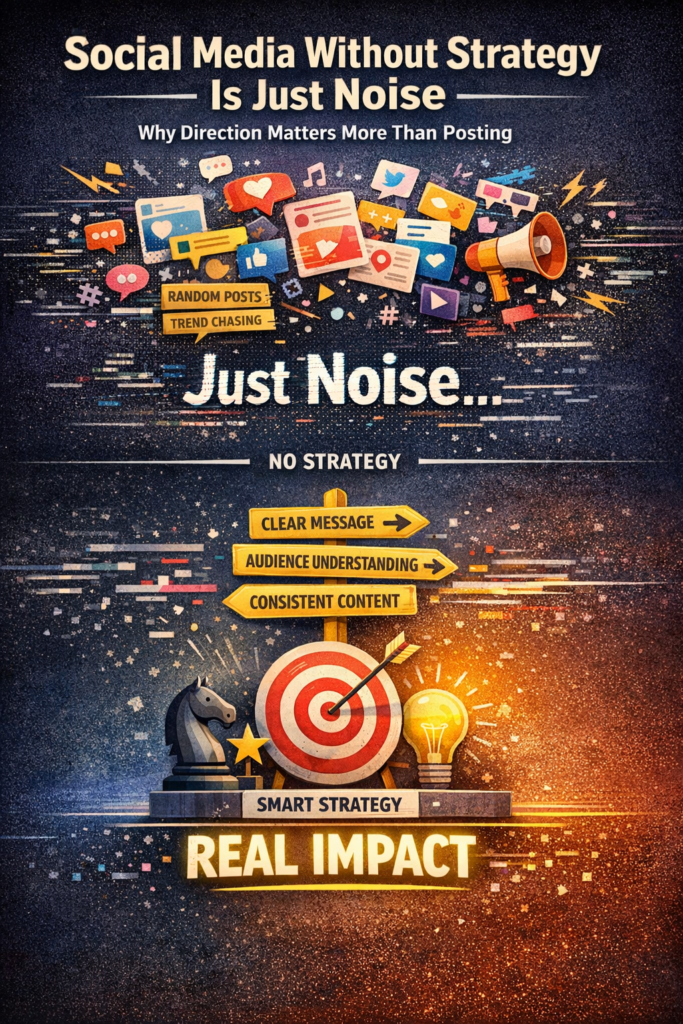
When content is created without purpose, it becomes noise — visible but forgettable.
Strategy Gives Content a Reason to Exist
Strategy is not about posting more. It is about knowing why content exists in the first place. A strategic approach defines the role social media plays in brand growth. Is it building awareness? Educating audiences? Creating trust? Generating leads? Supporting customer retention?
Without clarity, content decisions become random. Brands jump from motivational posts to promotional graphics to trending reels without a cohesive narrative. Each post may perform differently, but collectively they fail to build identity.
A clear strategy ensures that every piece of content contributes to a larger objective. It connects daily posts to long-term positioning. Instead of reacting to what is trending, brands communicate what they stand for.
When a strategy exists, content stops being an activity and becomes an asset.
Reactive Posting Creates a Scattered Brand Identity
One of the biggest risks of strategy-less content is inconsistency in brand perception. When posts are driven by trends or short-term engagement spikes, messaging shifts constantly. The brand appears active, but not coherent.
Audiences may see the content, but they struggle to understand what the brand represents. Without a stable message, familiarity cannot form. And without familiarity, trust cannot grow.
Social media rewards repetition of clear ideas. Not repetition of formats, but repetition of meaning. When a brand communicates consistent values and perspectives over time, audiences begin to recognize and remember it.
A reactive posting style does the opposite. It makes brands feel scattered, temporary, and interchangeable.
Understanding the Audience Mindset
Effective social media strategy begins with understanding how audiences think — not just what they like. What do they already believe? What problems do they fear? What expectations do they carry when they encounter a brand online?
Content that ignores this psychological context often feels intrusive. It demands attention instead of earning it. It speaks without listening.
Strategic content enters conversations naturally. It aligns with existing beliefs while gently shaping new ones. It does not interrupt the audience’s experience — it integrates into it.
When brands understand audience mindset, engagement becomes a byproduct rather than a target. People interact because the content resonates, not because it is optimized for clicks.
Strategy Reduces Creative Exhaustion
Posting without direction does not only confuse audiences — it also exhausts teams. When success is undefined, effort becomes scattered. Teams constantly search for new ideas, new formats, and new angles without knowing what actually works.
This creates pressure to post more instead of post better. Quantity replaces clarity. Over time, creativity declines because energy is spread thin across too many directions.
Strategy reduces this chaos. It sets boundaries. It defines themes, priorities, and communication pillars. Instead of asking “What should we post today?”, teams ask “What idea are we reinforcing today?”
This shift transforms content creation from guesswork into a system.
The Reality of Social Media in India
The Indian social media environment is intensely competitive. Attention is fragmented across platforms, languages, and content formats. Audiences scroll rapidly and forget quickly. Trends rise and disappear within hours.
In such a landscape, surface-level participation is not enough. Brands that rely only on trends struggle to maintain relevance. They gain temporary attention but fail to build memory.
Strategic content works differently. It builds familiarity through consistent messaging. When audiences repeatedly encounter the same core ideas, recognition forms. Recognition leads to trust. Trust leads to preference.
In a fast-moving ecosystem, clarity is more powerful than creativity alone.
Why Metrics Can Mislead Brands
Social media platforms offer an abundance of metrics — likes, shares, reach, impressions, watch time. While these numbers provide useful signals, they can also create false confidence.
A viral post may generate visibility without contributing to long-term growth. High engagement may reflect entertainment value rather than brand relevance. Numbers can measure attention, but they cannot measure meaning.
Strategy reframes success. Instead of asking “How many people saw this?”, it asks:
-
Did this strengthen brand clarity?
-
Did audiences understand our message?
-
Did it contribute to recognition over time?
-
Did it start meaningful conversations?
Metrics matter, but interpretation matters more. True impact is measured through recall, trust, and positioning — outcomes that cannot be captured by numbers alone.
Social Media as Communication, Not Just Entertainment
Many brands treat social media purely as an entertainment platform. While engaging content is important, communication should remain the priority. Social media is not just about being interesting — it is about being understood.
When brands focus only on entertainment, messaging becomes shallow. Content may attract attention, but it rarely shapes perception. Entertainment without communication builds audiences but not influence.
Strategic social media balances engagement with intention. It informs, persuades, reassures, and positions. It speaks clearly and consistently.
When content communicates meaning, it accumulates value over time.
Strategy Turns Content Into a System
Without strategy, social media is unpredictable. Results depend on trends, algorithms, and chance. Posting becomes a gamble.
With strategy, content becomes a system. Ideas connect. Messages reinforce each other. Each post strengthens what came before it. Growth becomes cumulative rather than temporary.
This systematic approach transforms how brands experience social media. Instead of chasing attention, they build authority. Instead of reacting to platforms, they shape perception.
In an environment where everyone can publish, strategy is what differentiates communication from noise.
The Future of Social Media Belongs to Clear Brands
As platforms evolve and competition intensifies, clarity will become the defining advantage. Brands that know what they stand for will be remembered. Brands that post without direction will remain visible but forgettable.
Social media does not reward activity alone. It rewards meaning delivered consistently over time. Strategy gives content purpose, coherence, and impact.
Without a strategy, brands speak loudly but say nothing. With strategy, even simple content can shape perception and drive growth.