
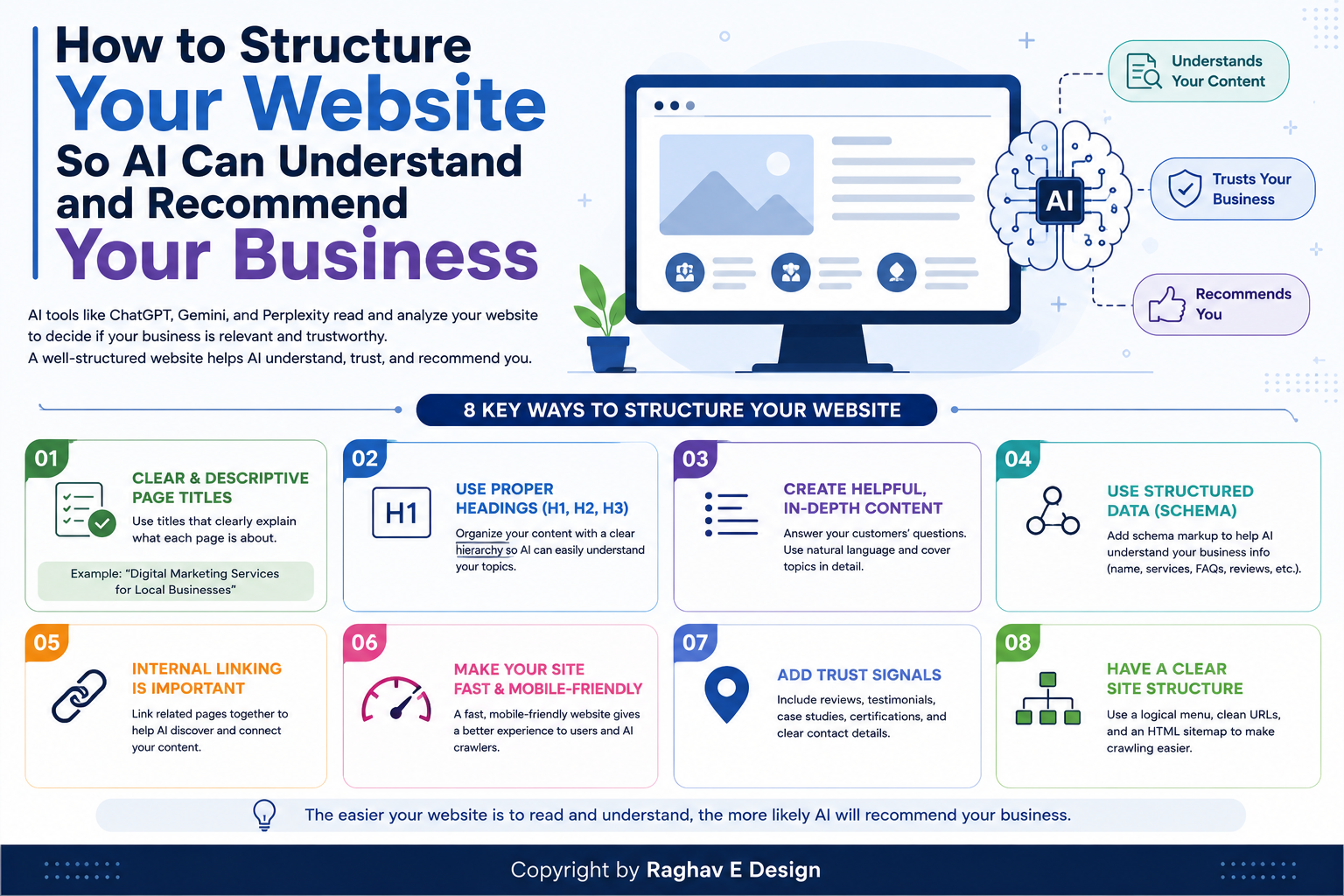
More people are asking AI tools like ChatGPT, Google's AI Overviews, and Perplexity for business recommendations before they ever open a search results page. If your website isn't built in a way these tools can read and interpret correctly, you're invisible to a growing share of your potential customers. To structure your website for AI, you need clear content organization, honest and specific information, and technical markup that removes any guesswork about what your business actually does. This isn't a separate discipline from good web design and SEO — it's an extension of it, with a few extra details that matter more now than they used to.
This article walks through exactly what that structure looks like, why it matters, and how to apply it without overhauling your entire site.
What Does It Mean for AI to "Understand" a Website?
AI tools don't browse a website the way a human does. They rely on crawlers and language models that break a page into chunks of text, headings, and structured data, then try to figure out what each chunk means and how it relates to the rest of the page.
When AI "understands" your website, it means the system can accurately answer questions like:
- What does this business actually sell or do?
- Where is it located, and does it serve this customer's area?
- What makes it different from competitors?
- Is the information current and trustworthy?
If your site buries this information in vague marketing language, unlabeled images, or JavaScript-heavy sections that don't render as plain text, AI systems often skip over it or misinterpret it entirely.
Why This Matters for Your Business
Search behavior is shifting. People are asking conversational questions and getting direct answers, sometimes without clicking through to any website at all. When they do click through, it's usually because an AI tool has already decided your business is a relevant, trustworthy answer.
This shift affects businesses of every size, but it hits harder for local and service-based businesses — companies offering website development, marketing, or app development, for example — because AI tools are increasingly used to shortlist vendors before a human even starts comparing options manually.
A site that isn't structured clearly won't necessarily disappear from Google entirely, but it will consistently lose ground to competitors whose content is easier to parse, verify, and quote.
Benefits of an AI-Friendly Website Structure
- Higher visibility in AI-generated answers, not just traditional search rankings
- Better accuracy when AI tools describe your business to users
- Improved SEO performance overall, since a clean structure benefits both AI systems and search crawlers
- Fewer support questions, because clearer information means visitors and AI both understand your offerings the first time
- Stronger credibility, since structured, specific content reads as more trustworthy than vague copy
Step-by-Step Process to Structure Your Website for AI
Step 1: Organize Content Around Clear Topics
Each page should focus on one clear subject. A page mixing five unrelated services with no clear separation is harder for AI to summarize accurately than five well-defined pages, each answering a specific question a customer might ask.
Step 2: Use Descriptive, Logical Headings
Headings should describe the content that follows them in plain language. Instead of a heading like "Our Approach," use something specific like "How We Build Custom Websites for Small Businesses." AI systems rely heavily on headings to map out page structure.
Step 3: Write in Direct, Specific Language
Avoid vague claims. Instead of saying you offer "comprehensive digital solutions," specify exactly what you do: website development, Google Ads management, SEO, or app development. Specificity is what AI tools extract and repeat.
Step 4: Add Structured Data (Schema Markup)
Schema markup tells AI systems and search engines exactly what type of content they're looking at — a business, a service, an article, a review, or an FAQ. This is one of the most direct ways to reduce ambiguity for machines reading your site.
Step 5: Keep Business Information Consistent Everywhere
Your business name, address, phone number, and service descriptions should match exactly across your website, Google Business Profile, and any directories you're listed in. Inconsistencies confuse AI systems trying to verify your business details.
Step 6: Make Sure Content Is Crawlable
If key information only loads through JavaScript interactions or is hidden inside images without alt text, many AI crawlers will miss it. Core content should exist as readable HTML text.
Step 7: Answer Real Questions Your Customers Ask
Structure sections around actual questions people search for. This naturally aligns your content with how conversational AI tools process and retrieve information.
Best Practices
- Keep paragraphs short and focused on a single idea.
- Use bullet points and numbered lists for processes, benefits, or comparisons.
- Include an FAQ section addressing specific, realistic customer questions.
- Update outdated information promptly — AI tools favor current, accurate content.
- Link related pages internally so AI can understand how your services connect.
Common Mistakes to Avoid
- Vague, jargon-heavy copy that sounds impressive but says nothing specific.
- Missing or incorrect schema markup, or copying schema code without customizing it.
- Inconsistent business details across the web.
- Overloading a single page with every service you offer instead of separating them clearly.
- Ignoring image and media accessibility leaves visual content unreadable to AI.
Practical Tips
- Test how your page reads with formatting stripped away — if the message is still clear as plain text, that's a good sign.
- Review your site's schema markup periodically, since services and details change over time.
- Ask real customer questions in your FAQ section rather than generic ones.
- Keep your service pages focused, specific, and free of unnecessary filler.
Frequently Asked Questions
1. What is meant by "structuring a website for AI"? It means organizing your content, headings, and technical markup so AI tools and search engines can accurately interpret what your business offers and represent it correctly to users.
2. Does this replace traditional SEO? No. It builds on the same foundation — clear content, good technical structure, and relevant keywords — with added attention to structured data and direct, specific language that AI systems can parse easily.
3. Is schema markup necessary for every business? It's strongly recommended. Schema markup removes ambiguity about what your content represents, which helps both AI tools and search engines categorize your business correctly.
4. Can a small business benefit from this, or is it only for large companies? Small and local businesses often benefit the most, since AI-driven recommendations are increasingly used for local and service-based searches.
5. How long does it take to see results after restructuring a website? Timelines vary depending on how frequently AI tools and search engines re-crawl your site, but many businesses notice improved clarity in search snippets and AI summaries within a few weeks of consistent updates.
6. Do I need to redesign my entire website? Not necessarily. Many improvements involve reorganizing content, refining headings, and adding structured data rather than a full visual redesign.
7. How does this affect my Google rankings? Clearer structure and accurate schema markup generally support better search performance overall, since both AI systems and traditional search crawlers benefit from well-organized, specific content.
Conclusion
Structuring your website so AI can understand it isn't a trend to chase — it's a natural next step in making your business easy to find, verify, and recommend, whether a visitor arrives through a traditional search or a conversation with an AI assistant. Clear content, honest specifics, consistent business information, and proper technical markup work together to make your website legible to both humans and machines. If you're not sure where your website currently stands, a professional review of your content structure and technical setup — the kind of work our team at Raghav E Design does through website development, SEO, and website optimization — can help you identify exactly what needs attention.
Contact us today
If you'd like a clear picture of how AI tools and search engines currently interpret your website, our team at Raghav E Design can review your site's structure, content, and technical setup and help you make it easier to find, understand, and recommend. Reach out to discuss your website development, SEO, or performance marketing needs.