
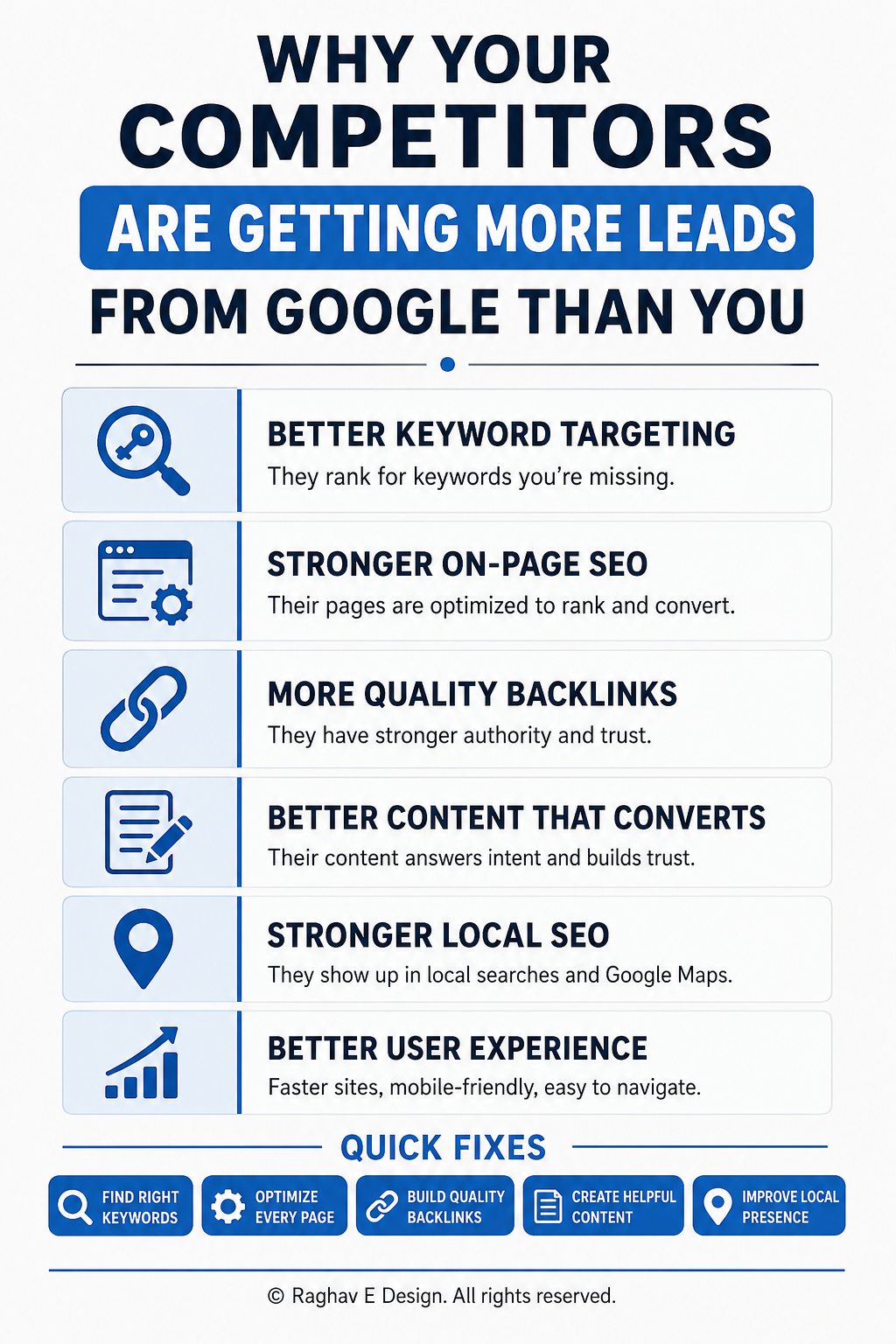
You search your own business category on Google, and there they are again — the same two or three competitors, sitting at the top, while your website is nowhere close. If you have ever wondered why your competitors are getting more leads from Google than you, you are not alone, and the answer is rarely about luck. It usually comes down to a handful of fixable gaps in your website, your ads, and how visible your business is when someone is actively searching for what you sell. This article breaks down exactly what separates businesses that consistently generate leads from Google and businesses that get overlooked, along with practical steps you can start using right away.
What It Means When Competitors Outperform You On Google
When a competitor shows up above you in search results or gets more clicks on their Google Ads, it means Google's algorithm — and the searcher — trusts their page more for that specific query at that specific moment. This trust is built from technical signals, content relevance, page speed, reviews, and how well the site matches what the searcher is actually looking for. It has little to do with which company is "better" and everything to do with which company has done the groundwork correctly.
Why This Gap Matters For Your Business
Every day, someone searches for your service on Google; they have a problem they want solved right now. If your competitor's page loads faster, answers the searcher's question more clearly, or runs a sharper ad campaign, that lead goes to them instead of you — even if your product or service is just as good, or better. Over months and years, this compounds into a real difference in revenue, not just rankings.
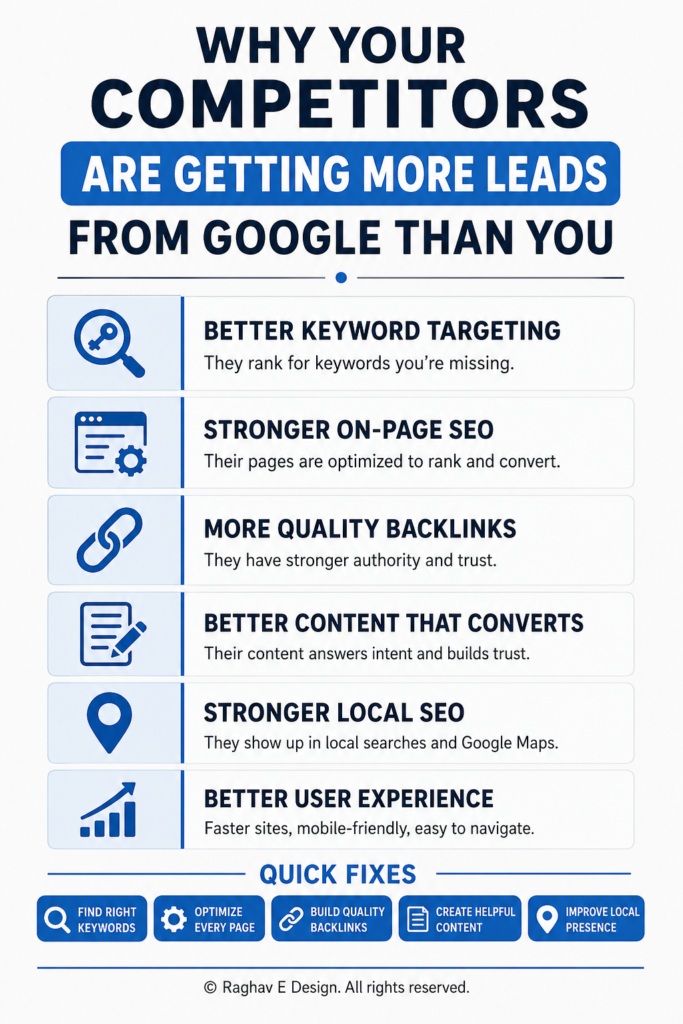
Common Reasons Competitors Get More Leads
Weak On-Page and Technical SEO
Missing title tags, thin content, duplicate pages, and poor internal linking all quietly push a website down the rankings. Many businesses have a website that looks fine but was never actually built with search visibility in mind.
A Slow or Outdated Website
Google factors page speed and mobile usability into rankings, and searchers abandon slow pages within seconds. A site that takes more than three seconds to load is often losing visitors before they even see the offer.
No Structured Google Ads Strategy
Competitors running well-targeted Google Ads campaigns, with tight keyword match types and clear landing pages, capture leads instantly, while businesses relying only on organic traffic wait months to see results — or run ads without proper tracking and waste the budget.
Missing Local SEO Signals
An incomplete or unoptimized Google Business Profile, inconsistent business listings, and a low volume of reviews all reduce visibility in local map results, which is often where the highest-intent leads come from.
A Content Strategy That Doesn't Match Search Intent
Publishing generic blog posts without researching what people are actually typing into Google means the content never ranks for the terms that bring in buyers, not just browsers.
No Clear Lead Capture System
Traffic without a strong call-to-action, a working contact form, or a fast follow-up process is traffic that simply leaves. Many websites drive visitors but give them no easy next step.
Benefits of Closing These Gaps
Fixing these areas does more than improve a ranking position. It leads to a steadier flow of inbound inquiries, a lower cost per lead over time as organic traffic grows, better quality leads because the content matches real search intent, and a website that keeps working for the business even outside paid campaigns.
Step-by-Step Process to Start Getting More Leads From Google
- Audit your current website for speed, mobile experience, and basic SEO health.
- Research the exact keywords your ideal customers are searching for, not just what you assume they search.
- Optimize your Google Business Profile with accurate categories, photos, and consistent business details.
- Rebuild key pages around search intent, with clear headings and a genuine answer to the visitor's question.
- Set up a focused Google Ads campaign for your highest-intent keywords, with a landing page built to convert.
- Add clear lead capture points — forms, click-to-call buttons, or a chatbot — throughout the site.
- Track results monthly and adjust based on what is actually converting.
Best Practices
Keep content genuinely useful rather than written only to include keywords. Update older pages regularly instead of only publishing new ones. Make sure every page has one clear purpose and one clear next step for the visitor. Pair organic SEO with paid ads so you are visible in both sections of the search results while your rankings build.
Common Mistakes To Avoid
Avoid stuffing keywords unnaturally, ignoring page speed, running ads without conversion tracking, letting your Google Business Profile sit unmanaged, and treating your website as a one-time project instead of something that needs ongoing attention.
Practical Tips
Check your website speed with a free tool at least once a quarter. Respond to every Google review, positive or negative. Review your Google Ads search terms report weekly to cut wasted spend. Ask happy customers for reviews right after a successful project, when they are most willing to leave one.
Frequently Asked Questions
Why are my competitors ranking higher even though my website looks better? Rankings depend on technical SEO, content relevance, and site speed far more than visual design. A page can look attractive and still be poorly optimized for search.
How long does it take to start getting more leads from Google? Organic SEO improvements typically take three to six months to show meaningful results, while a well-set-up Google Ads campaign can start generating leads within days.
Is Google Ads or SEO better for generating leads? They work best together. Google Ads brings faster, immediate visibility, while SEO builds a lasting source of leads that does not disappear when you pause a budget.
Does my Google Business Profile really affect leads? Yes. For local searches, an optimized and active Google Business Profile often influences visibility more than the website itself.
What is the most common reason websites fail to generate leads? Traffic without a clear next step. Many websites attract visitors but give them no obvious way to make contact or take action.
Can a slow website really cost me leads? Yes. Visitors commonly leave a page if it takes more than a few seconds to load, and Google also factors speed into rankings.
Conclusion
Getting more leads from Google is rarely about outspending competitors — it is about doing the fundamentals correctly and consistently: a fast, well-structured website, content that matches what people are actually searching for, an active Google Business Profile, and ads that are properly targeted and tracked. Once these pieces are in place, the businesses that were previously invisible in search results start showing up exactly when it matters. If you want a clear picture of where your website currently stands and what specifically is holding it back, Raghav E Design can help you review your SEO, Google Ads, and website performance and put a practical plan in place to close the gap.
Not sure why your competitors keep showing up first on Google? Raghav E Design can audit your website, SEO, and Google Ads setup and show you exactly what to fix to start generating more leads. Get in touch with Raghav E Design to book a free consultation.