
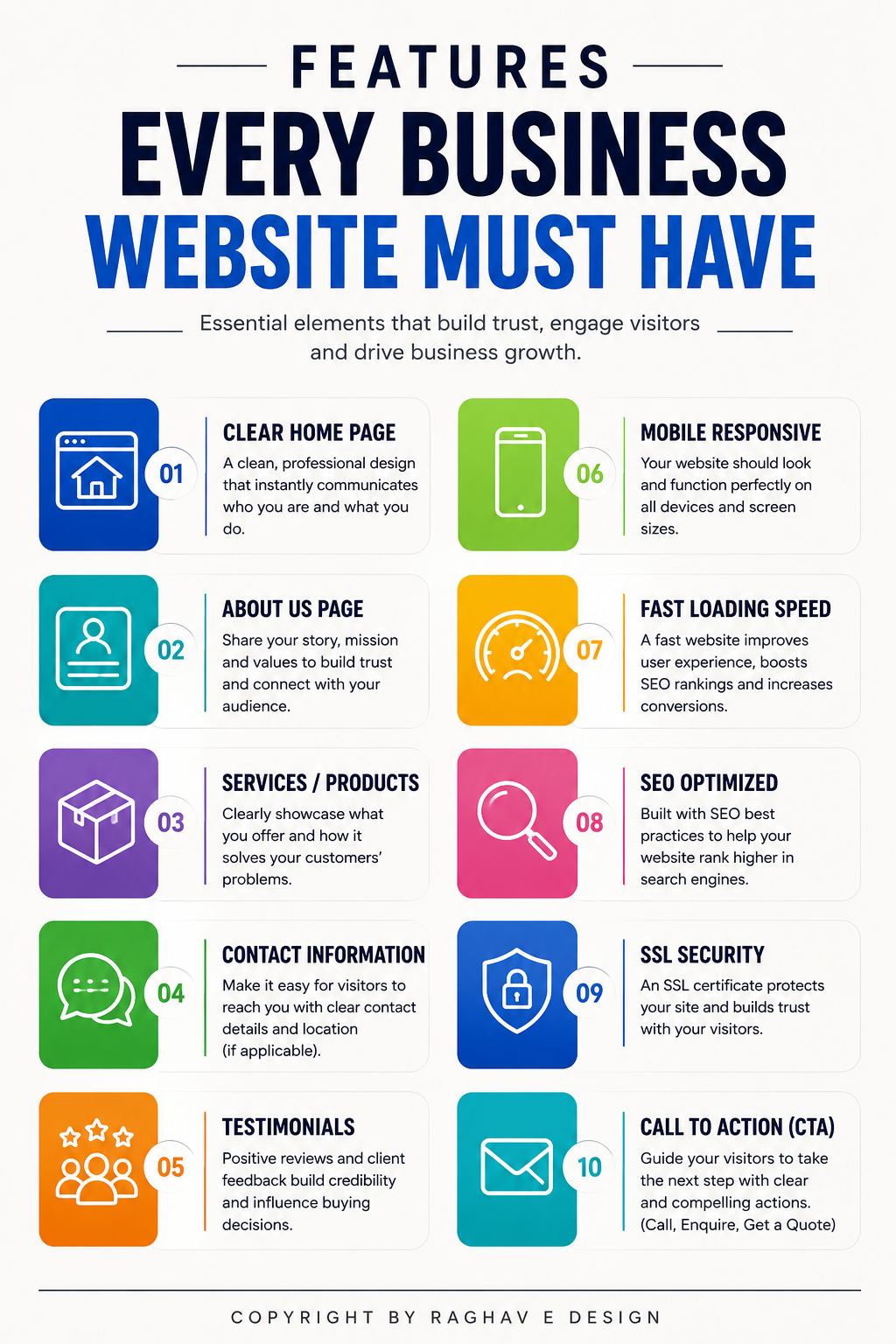
Your website is often the first place a potential customer forms an opinion about your business. Before they call you, email you, or walk through your door — they have already visited your website and made a judgment. If what they find is outdated, slow, or confusing, they leave. And they rarely come back.
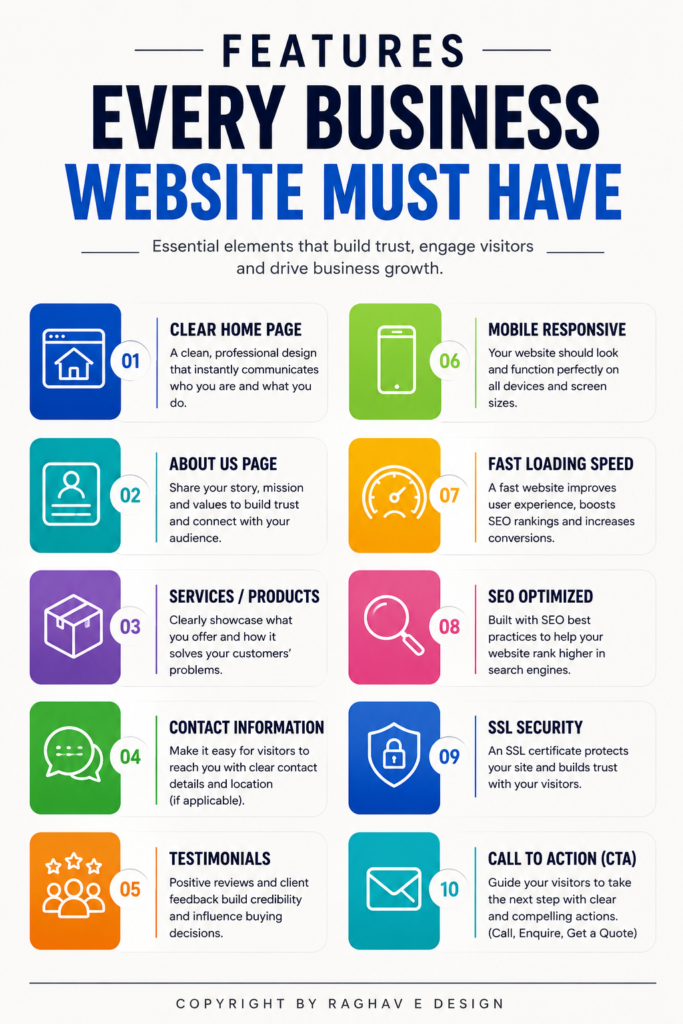
The good news is that most website problems are preventable. Knowing the features every business website must have gives you a clear standard to measure against — whether you are building from scratch or evaluating what you already have. This guide covers the ten non-negotiable elements that separate websites that generate business from ones that simply exist on the internet.
1. A Clear and Compelling Homepage
Your homepage has one job: tell visitors immediately who you are, what you do, and why they should care. Most people decide within seconds whether to stay or leave.
A strong homepage includes a headline that speaks directly to your customer's need, a short subheading that explains your solution, and a prominent call to action. Avoid cluttering it with everything your business has ever done. Focus, clarity, and a single clear next step win every time.
2. Mobile-Responsive Design
More than half of all web traffic comes from mobile devices. If your website does not adapt cleanly to different screen sizes, you are losing visitors before they even read your first line of content.
Mobile responsiveness is not optional — it is a baseline expectation. Google also uses mobile-first indexing, which means a poor mobile experience directly affects your search rankings. Every button, image, and block of text must work as well on a phone as it does on a desktop.
3. Fast Loading Speed
Why Speed Is a Ranking and Conversion Factor
A website that takes more than three seconds to load loses a significant portion of its visitors. People are not patient online, and slow websites signal poor quality — regardless of how good your services actually are.
Page speed also affects your Google Ads Quality Score, your SEO rankings, and your bounce rate. Compress your images, use reliable hosting, minimize unnecessary plugins, and enable caching. These are not technical luxuries — they are business necessities.
4. Features Every Business Website Must Have: A Dedicated Services or Products Page
One of the most commonly overlooked features every business website must have is a well-structured services or products page. Visitors need to understand exactly what you offer, what is included, and who it is for.
Each service should have its own section or page — with a clear description, the problem it solves, who it is best suited for, and a call to action. Vague descriptions like "we offer solutions for your needs" do not convert. Specific, benefit-driven copy does.
5. Trust Signals and Social Proof
People buy from businesses they trust. Your website needs to earn that trust visually and verbally before a visitor ever contacts you.
Features Every Business Website Must Have Effective trust signals include:
- Client testimonials with real names and specific results
- Case studies or project examples that show your work
- Certifications, awards, or media mentions
- Security badges and SSL certificates (the padlock in the browser)
- Real team photos rather than stock imagery
Even a few well-placed testimonials can meaningfully increase the number of people who take action on your website.
6. Clear Contact Information and Multiple Contact Options
If someone wants to reach you and cannot figure out how, you have lost that lead permanently. Your contact details should be easy to find — ideally in the header, footer, and on a dedicated contact page.
Offer more than one way to get in touch. Some people prefer calling, others prefer email, and many now expect a live chat or chatbot option. A contact form with just a few fields — name, email, message — removes friction and encourages more enquiries. The fewer steps between interest and contact, the better.
7. Search Engine Optimized Structure
A beautifully designed website that nobody can find is not doing its job. Basic on-page SEO should be built into every page from the beginning — not added as an afterthought.
This includes:
- Descriptive page titles and meta descriptions
- Proper heading hierarchy (H1, H2, H3)
- Clean, keyword-friendly URLs
- Alt text on all images
- Fast load times and mobile optimization
- Internal linking between relevant pages
SEO is the long-term engine that brings consistent, free traffic to your website — and it starts with how your website is built.
8. A Blog or Resource Section
A blog serves two purposes simultaneously: it improves your search engine visibility, and it demonstrates your expertise to visitors who are still in the research phase.
Businesses that publish helpful, relevant content consistently attract more organic traffic over time. Each article is an additional entry point into your website from Google. A well-maintained blog also gives you content to share across social media and email, extending your reach without paid advertising.
9. Strong Calls to Action Throughout the Website
A call to action (CTA) tells visitors what to do next. Without them, people read your content and then leave — not because they are not interested, but because you never asked them to take a step.
Every page needs at least one clear CTA. It does not always have to be "Buy Now" — it could be "Get a Free Quote," "Book a Consultation," "Download Our Guide," or "Chat With Us." The key is that the CTA matches where the visitor is in their decision-making process and makes the next step obvious and easy.
10. Analytics and Tracking Setup
You cannot improve what you do not measure. Every business website should have Google Analytics and Google Search Console properly configured from day one.
These tools tell you how many people visit your website, where they come from, which pages they spend time on, and where they drop off. If you run Google Ads or Meta Ads campaigns, proper tracking also shows you which campaigns are actually generating enquiries and sales — not just clicks.
Without data, you are making decisions based on guesswork. With it, you can refine and improve continuously.
Common Mistakes Businesses Make With Their Websites
- No clear value proposition on the homepage — visitors do not understand what you do
- Missing or buried contact information makes it hard for interested visitors to reach you
- No SSL certificate — browsers flag your site as "Not Secure," which destroys trust instantly
- Generic stock photography — undermines authenticity and makes you look like every other website
- No calls to action — visitors have nowhere to go after reading your content
- Ignoring website speed — slow sites lose visitors and rank lower on Google
Practical Tips to Improve Your Business Website Right Now
- Audit your homepage with fresh eyes — does it clearly explain what you do within five seconds?
- Check your website on a mobile device and look for anything broken or hard to tap
- Run your site through Google PageSpeed Insights and fix the top issues flagged
- Add at least two or three genuine client testimonials with specific details
- Make sure your phone number and email are visible on every page
- Set up Google Search Console if you have not already — it is free and essential. Features Every Business Website Must Have
Conclusion
A business website that works is not about how it looks — it is about how it performs. The features every business website must have are not design trends or technical gimmicks. They are the fundamentals that build trust, attract visitors, and turn browsers into buyers.
If your current website is missing several items on this list, it is worth addressing them properly rather than patching things one at a time. At Raghav E Design, we build websites that check every box — from mobile-responsive design and SEO structure to speed optimization, lead capture, and analytics setup. If you want a website that actively supports your business growth, we are here to help you build it right.
FAQ Section
Frequently Asked Questions
Q1. What are the most important features a business website must have?
The most essential features include a clear homepage, mobile-responsive design, fast loading speed, a dedicated services page, trust signals like testimonials, easy contact options, SEO-optimized structure, a blog, strong calls to action, and proper analytics tracking.
Q2. How many pages should a business website have?
At minimum, a business website should have a Homepage, About page, Services or Products page, Contact page, and a Blog. Additional pages depend on the number of services, locations, or products you offer. More focused, well-written pages are better than many thin, underdeveloped ones.
Q3. Why is mobile responsiveness important for a business website?
Over half of all internet traffic comes from mobile devices. A website that does not display correctly on phones and tablets loses visitors, damages your brand perception, and ranks lower on Google due to its mobile-first indexing policy.
Q4. Do I really need a blog on my business website?
Yes, if organic traffic matters to you. A blog helps your website rank for a wider range of search terms, demonstrates your expertise, and gives visitors a reason to keep returning. Even publishing one or two quality articles per month makes a measurable difference over time.
Q5. What is a call to action and why does every page need one?
A call to action (CTA) is a prompt that tells the visitor what to do next — such as "Contact Us," "Get a Quote," or "Book a Call." Without CTAs, visitors read your content and leave without engaging. Every page should have at least one CTA that guides the visitor toward the next logical step.
Q6. How does website speed affect my business?
Slow websites increase bounce rates, reduce conversions, lower Google rankings, and increase cost-per-click for paid ads. A one-second delay in page load time can significantly reduce the percentage of visitors who take action. Speed is a direct business metric, not just a technical one.
Q7. What tracking tools should my business website have?
At minimum, every business website should have Google Analytics 4 for traffic and behaviour data, and Google Search Console for search performance monitoring. If you run paid campaigns, proper conversion tracking through Google Tag Manager is also essential.
Q8. Can I add these features to my existing website, or do I need to rebuild it?
Many features — like adding testimonials, CTAs, a blog, and analytics — can be added to an existing website. However, if your site has structural issues like poor mobile responsiveness, slow speed, or a weak SEO foundation, a rebuild is often more cost-effective than repeated fixes.
Is Your Website Missing Any of These Features?
At Raghav E Design, we audit, redesign, and build business websites that are fast, mobile-ready, SEO-optimized, and built to generate real enquiries. Whether you need a complete website or targeted improvements to what you already have — our team delivers results without the guesswork.
📩 Contact Raghav E Design today for a free website review and find out exactly what your site needs to perform better.