
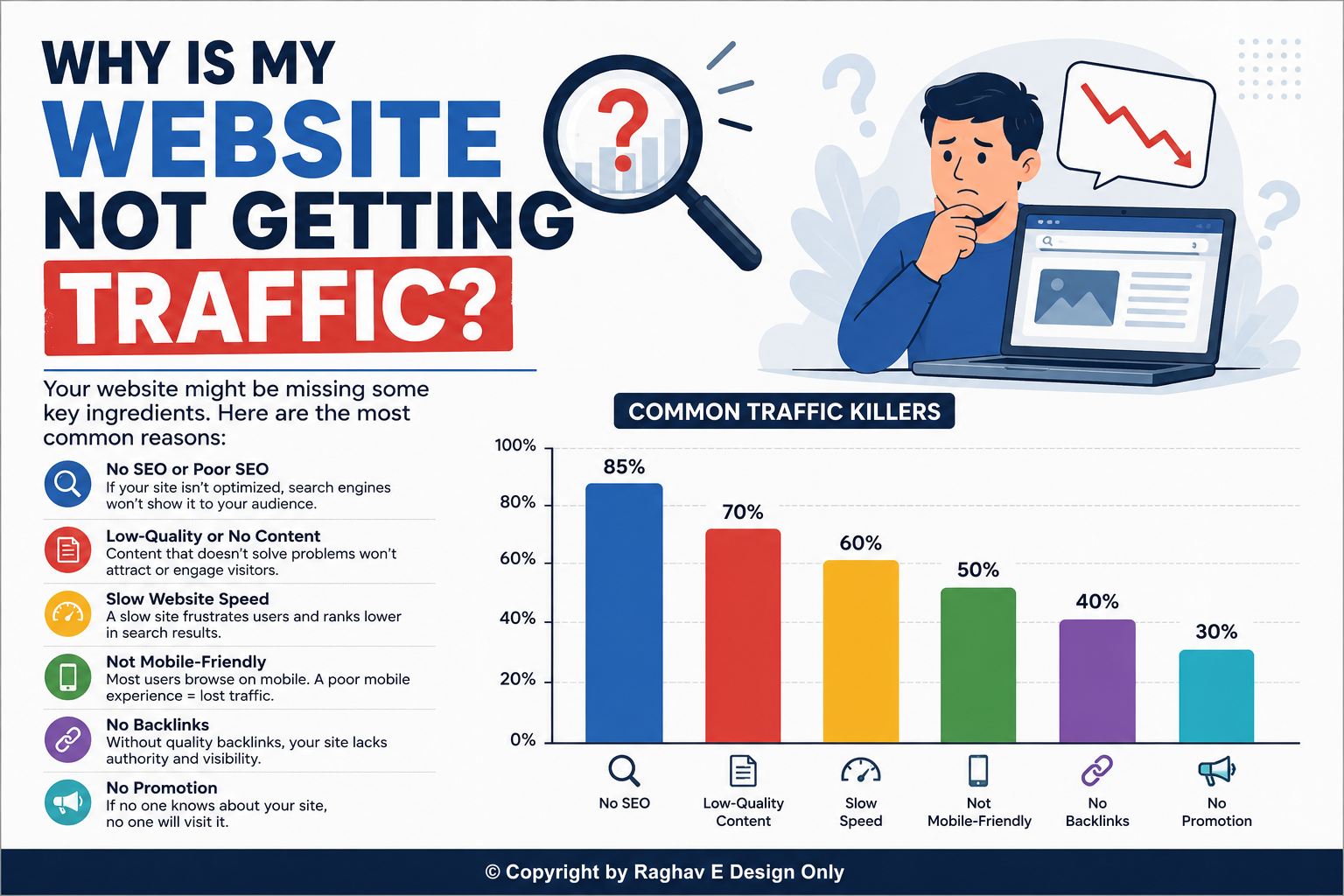
You built the website. You published the pages. You may have even shared it a few times on social media. And yet — almost nobody is visiting.
This is one of the most common frustrations business owners and marketers face. A website that sits invisible on the internet is not just disappointing — it is a genuine business problem. Every day without traffic is a day without potential customers discovering what you offer.
The encouraging part is that low website traffic almost always has a fixable cause. This article walks through the most common reasons your website is not getting traffic and, more importantly, what you can actually do about each one.
Your Website Is Not Optimised for Search Engines
This is the number one reason most websites struggle. If your website is not built with SEO in mind, Google simply does not know when to show it — or to whom.
Search engine optimisation is not about stuffing keywords into every sentence. It is about giving Google clear signals about what your pages are about, who they are for, and why they deserve to rank.
Common SEO Gaps That Kill Traffic
- No target keywords on your pages — if your content does not match what people actually type into Google, it will not appear in results
- Missing or weak meta titles and descriptions — these tell both search engines and users what your page is about
- No heading structure — pages with no H1, H2, or H3 headings are harder for Google to interpret
- Thin content — pages with only a few sentences rarely rank because they do not provide enough value
- No internal linking — without links between your own pages, Google struggles to understand your site's structure
If SEO has never been a priority on your website, this is almost certainly the first place to focus.
Your Website Is Too New
If your website launched recently, low traffic may simply be a timing issue. Google takes time to crawl, index, and assess new websites before ranking them.
This process — sometimes called the "Google sandbox" — can take anywhere from a few weeks to several months. During this period, even well-optimised websites receive little organic traffic.
The solution here is consistency. Keep publishing quality content, build credibility over time, and make sure your website is submitted to Google Search Console so Google knows it exists.
You Are Targeting Keywords Nobody Searches For
Many website owners write content about topics they find interesting or use language their industry uses internally — rather than the exact words their customers type into Google.
For example, a cleaning company might write a page titled "Our Hygiene Solutions" when potential customers are searching for "professional cleaning services near me." The gap between how you describe your business and how customers search for it can completely block your traffic.
Keyword research is not complicated, but it is essential. Understanding the actual words and phrases your target audience uses — and building your content around those terms — is one of the highest-impact things you can do for your website's visibility.
Your Website Has Technical Problems
Even great content will not rank if your website has technical issues that prevent Google from accessing or understanding it.
Technical Issues That Block Traffic
- Pages blocked from indexing — a single misconfigured setting can tell Google not to index your site
- Broken links and error pages — too many 404 errors signal poor site quality
- Slow loading speed — Google penalises slow websites, and visitors leave before the page even loads
- Poor mobile experience — Google uses mobile-first indexing, meaning your mobile site is the version that gets ranked
- No SSL certificate — websites without HTTPS are flagged as insecure, which damages both trust and rankings
A technical SEO audit can uncover these issues quickly. Many of them take only minutes to fix once identified.
You Have No Backlinks
Backlinks — links from other websites pointing to yours — are one of Google's most important ranking signals. They act as votes of confidence. The more credible websites that link to you, the more authority Google assigns to your site.
A brand new website with no backlinks starts with zero authority. Without at least some backlinks, it is very difficult to rank for competitive keywords regardless of how good your content is.
Building backlinks takes time, but it does not have to be complicated. Getting listed in relevant directories, earning mentions from local publications, guest posting on industry blogs, and creating content others want to reference are all legitimate ways to build your link profile gradually.
Your Content Does Not Match Search Intent
Search intent is the reason behind a search query. When someone types a question into Google, they have a specific goal — they want to learn something, find something, or buy something.
If your content does not match that intent, Google will not rank it — even if it contains the right keywords.
For example, someone searching "how to choose a web hosting plan" wants a guide, not a sales page. If you send them to a product page, Google recognises the mismatch and ranks a more relevant result instead.
Before creating any piece of content, ask yourself: what does someone searching this phrase actually want to find? Then build your content to give them exactly that.
You Are Relying Only on Organic Traffic
SEO is powerful, but it takes time. If your website is new or your organic rankings are still developing, waiting for Google to send you traffic means waiting months before seeing results.
Many businesses make the mistake of treating paid traffic and organic traffic as competing strategies. They work best together.
Running targeted Google Ads or Meta Ads while your SEO builds momentum means you are not leaving potential customers on the table during the slow early phase. Paid campaigns also give you immediate data — you learn which messages resonate, which pages convert, and which audiences respond — insights that directly improve your organic strategy too.
You Are Not Promoting Your Content
Publishing a blog post or a new page and then doing nothing else is one of the most common mistakes website owners make. Content does not promote itself.
Sharing your content consistently through social media, email newsletters, and community groups puts it in front of people who may link to it, share it further, or visit your website directly. Each of those actions gradually builds your website's authority and reach.
Even a small, consistent promotion habit compounds meaningfully over time.
What to Do Next
If your website is not getting traffic, the problem is rarely one single thing — it is usually a combination of gaps in SEO, content strategy, technical health, and promotion working against each other.
Start with an honest audit. Check whether Google can actually find and index your pages. Look at whether your content targets real search queries. Assess your site speed on mobile. Identify whether you have any backlinks at all.
Fixing these issues one by one — consistently and correctly — is how websites go from invisible to generating genuine, qualified traffic.
Not Sure Why Your Website Is Not Getting Traffic?
Sometimes the issue is technical. Sometimes it is content. Often it is both. At Raghav E Design, we help businesses identify exactly what is holding their website back and build a clear path forward.
Whether you need a full SEO strategy, a website that is properly optimised from the ground up, or paid campaigns through Google Ads or Meta Ads to drive immediate results while your organic presence grows — we work with you based on what your website actually needs, not a one-size-fits-all package.
Reach out to Raghav E Design and let us take a proper look at your website. No jargon, no pressure — just an honest assessment and a practical plan to start growing your traffic.
FAQ Section
Frequently Asked Questions
Q1. Why is my website not getting any traffic even after months?
If your website has been live for several months and still receives little to no traffic, the most likely causes are a lack of SEO optimisation, no backlinks, targeting keywords with no search volume, or technical issues preventing Google from indexing your pages. Start with a Google Search Console check to see whether your pages are being indexed at all, then audit your content and keyword strategy.
Q2. How long does it take for a new website to get traffic?
A new website typically takes three to six months to start receiving meaningful organic traffic from Google. This timeline depends on how competitive your niche is, how frequently you publish quality content, and how actively you build backlinks. Paid advertising through Google Ads or Meta Ads can generate traffic immediately while your organic presence develops.
Q3. How do I check if Google has indexed my website?
Type site:yourwebsite.com into Google search. If pages appear in the results, Google has indexed your site. If nothing appears, your website may be blocked from indexing due to a misconfigured robots.txt file, a noindex tag, or simply because Google has not crawled it yet. Setting up Google Search Console is the most reliable way to monitor your indexing status.
Q4. Can a slow website affect my traffic?
Yes, significantly. A slow-loading website increases your bounce rate — meaning visitors leave before the page fully loads. Google also uses page speed as a ranking factor, so slow websites tend to rank lower in search results. Use tools like Google PageSpeed Insights to identify what is slowing your site down and fix the most impactful issues first.
Q5. Does social media help increase website traffic?
Social media does not directly improve your Google rankings, but it does drive referral traffic and increase the visibility of your content. When more people see and share your content, it creates more opportunities for backlinks, brand searches, and direct visits — all of which indirectly support your SEO over time.
Q6. What is the fastest way to get traffic to my website?
The fastest way to drive traffic to a website is through paid advertising — specifically Google Ads for search-intent traffic and Meta Ads for audience-based targeting. These channels can send visitors to your website within hours of launching a campaign. For long-term sustainable traffic, SEO and consistent content publishing remain the most cost-effective approach.
Q7. Why is my website ranking on Google but still not getting clicks?
Ranking on Google and getting clicks are two different things. If your page ranks but nobody clicks, the issue is usually a weak meta title or meta description that does not encourage people to click through. Your title should clearly communicate what the reader will get, and your meta description should reinforce that with a compelling reason to visit your page over the others.
Q8. Do I need a blog to get traffic to my website?
Not necessarily, but a blog significantly increases your chances of ranking for a wider range of search queries. Service pages alone can only target so many keywords. A blog allows you to create helpful, informative content that answers the questions your potential customers are already searching for — bringing them to your website at the research stage, before they are ready to buy.