
If you have ever typed "Google Ads cost in India" into a search bar, you probably got a dozen different answers, and none of them felt useful. Some agencies quote a flat monthly fee, others talk only about cost per click, and most skip the part that actually matters — how much you should realistically budget for your industry and goals. This guide breaks down real pricing patterns, the factors that push costs up or down, and a practical way to plan your Google Ads budget in 2026. Whether you run a local shop or manage marketing for a growing company, understanding these numbers before you spend a single rupee will save you from costly guesswork.
What Is Google Ads Cost in India
Google Ads works on an auction system. You do not pay a fixed price for a placement; you bid against other advertisers targeting the same keywords, and the final cost per click (CPC) depends on competition, ad quality, and relevance. In India, this means costs vary widely between a tier-1 city like Mumbai and a smaller town, and between a highly competitive industry like insurance and a niche one like handmade furniture.
Google Ads cost in India is usually measured through three common billing models: cost per click, cost per thousand impressions (CPM), and cost per action (CPA) for conversion-focused campaigns. Most small and mid-sized businesses start with CPC campaigns because they offer the most control over daily spending.
Why Google Ads Cost Matters for Indian Businesses
Setting a budget without understanding pricing trends often leads to two outcomes: overspending on broad, unfocused campaigns or underfunding a campaign so much that it never gathers enough data to perform well. Knowing typical costs helps you set realistic expectations, compare agency quotes, and avoid campaigns that drain budget without generating leads.
For businesses relying on paid traffic as a primary growth channel, even a small miscalculation in daily bids can mean the difference between a profitable campaign and a wasted quarter.
Average Google Ads Cost in India (2026)
Pricing has shifted gradually over the past few years as more businesses compete for the same keywords. As a general guide:
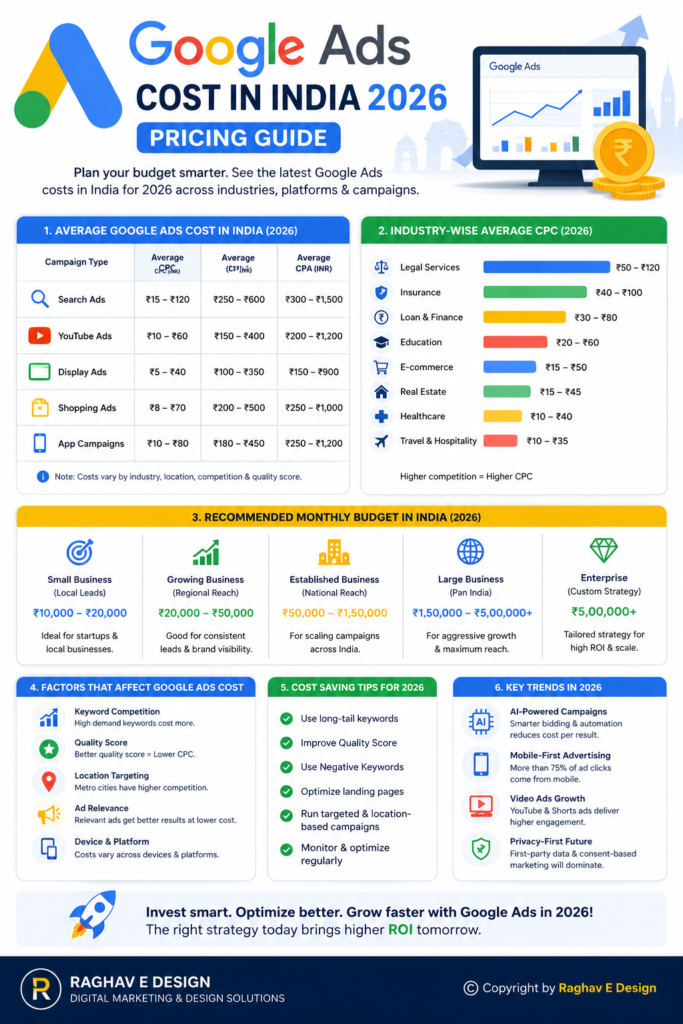
- Low-competition keywords (local services, niche products): ₹5 to ₹20 per click
- Medium-competition keywords (retail, education, healthcare): ₹15 to ₹50 per click
- High-competition keywords (finance, insurance, real estate, legal): ₹40 to ₹150+ per click
These are broad ranges, not fixed numbers. Actual CPC depends heavily on your specific keywords, location targeting, and how well your ads and landing pages are optimized.
Cost by Industry
E-commerce and retail businesses typically see moderate CPCs but need larger daily budgets due to high search volume. Service-based businesses like clinics, salons, or coaching institutes often pay less per click but need tighter geographic targeting to avoid wasted spend. B2B and financial services usually face the highest CPCs because the value of a single converted lead is much higher.
Cost by Campaign Type
Search campaigns generally cost more per click than Display campaigns, since search ads target users actively looking for a solution. Display and YouTube campaigns cost less per impression but require stronger creative to convert. Shopping campaigns for e-commerce brands often have a lower CPC but need accurate product feed management to stay cost-efficient.
Factors That Affect Google Ads Cost in India
Several elements influence what you actually pay:
- Keyword competition — More advertisers bidding on the same term push CPC higher.
- Quality Score — Google rewards relevant, well-structured ads and landing pages with lower costs.
- Location targeting — Metro cities usually cost more than tier-2 or tier-3 regions.
- Ad relevance and click-through rate — Ads that match search intent closely tend to cost less per click over time.
- Device targeting — Mobile and desktop CPCs can differ depending on the industry.
- Seasonality — Festive seasons, exam periods, or year-end sales can temporarily raise competition and cost.
Step-by-Step Process to Estimate Your Google Ads Budget
- Define your goal — leads, sales, app installs, or brand visibility.
- Research your target keywords using Google's Keyword Planner to see estimated CPC ranges.
- Calculate your target cost per lead or sale based on your profit margins.
- Set a daily budget that allows at least 15–20 clicks per day for meaningful data collection.
- Run a two-week test campaign to gather real performance data specific to your business.
- Adjust bids and targeting based on which keywords and audiences convert best.
Best Practices to Reduce Google Ads Cost
- Focus on long-tail, intent-specific keywords instead of broad, expensive terms.
- Use negative keywords to filter out irrelevant clicks.
- Improve landing page speed and relevance to raise Quality Score.
- Test multiple ad variations to identify the highest-performing copy.
- Narrow location and audience targeting instead of running nationwide campaigns by default.
- Review search term reports weekly to catch wasted spend early.
Common Mistakes That Increase Google Ads Cost
- Bidding on broad match keywords without proper monitoring.
- Ignoring mobile users while targeting only desktop-optimized landing pages.
- Running campaigns without conversion tracking makes it impossible to know what is working.
- Setting budgets too low to gather enough data before making decisions.
- Neglecting ad extensions, which can improve click-through rate and lower effective cost.
Practical Tips to Get Better ROI
Pair your Google Ads strategy with a well-optimized website and clear conversion path — a fast-loading page with a simple form or click-to-call button often outperforms a slower, cluttered one, regardless of how much you spend on clicks. Combining paid search with strong on-page SEO also reduces long-term dependency on rising ad costs. If you are unsure where your budget is leaking, a professional account audit can often reveal quick wins before you increase spending further.
Frequently Asked Questions
1. What is the minimum budget to start Google Ads in India? There is no fixed minimum, but most small businesses see workable results starting from ₹300 to ₹500 per day, enough to gather 10–15 clicks daily for testing.
2. Why does Google Ads cost vary so much between businesses? Cost depends on keyword competition, industry, Quality Score, and targeting settings, so two businesses in different sectors can pay very different rates for similar traffic volume.
3. Is Google Ads cost in India higher in metro cities? Generally, yes, since competition and search volume are higher in cities like Delhi, Mumbai, and Bengaluru compared to smaller towns.
4. How can I lower my Google Ads cost per click? Improving Quality Score through relevant ads, better landing pages, and using negative keywords are the most effective ways to reduce CPC over time.
5. Does a higher budget guarantee better results? Not necessarily. A well-optimized campaign with a moderate budget often outperforms a poorly targeted campaign with a large budget.
6. How long before Google Ads starts showing results? Most campaigns need two to four weeks of consistent running and optimization before performance data becomes reliable enough to judge properly.
7. Should I manage Google Ads myself or hire an agency? If you have the time to learn bidding strategies, keyword research, and tracking setup, self-management can work. Many businesses prefer professional management to avoid early-stage budget waste.
Conclusion
Understanding Google Ads cost in India is less about memorizing a fixed number and more about knowing how competition, targeting, and campaign quality interact to shape your final spend. With the ranges and factors covered here, you now have a realistic starting point to plan a budget that fits your goals instead of guessing. If you would rather have a team handle keyword research, bidding strategy, and ongoing optimization for you, Raghav E Design offers Google Ads management built around measurable results.
Planning a Google Ads campaign for 2026 and want a budget that actually delivers leads? Talk to the team at Raghav E Design for a practical Google Ads strategy tailored to your industry and location.